

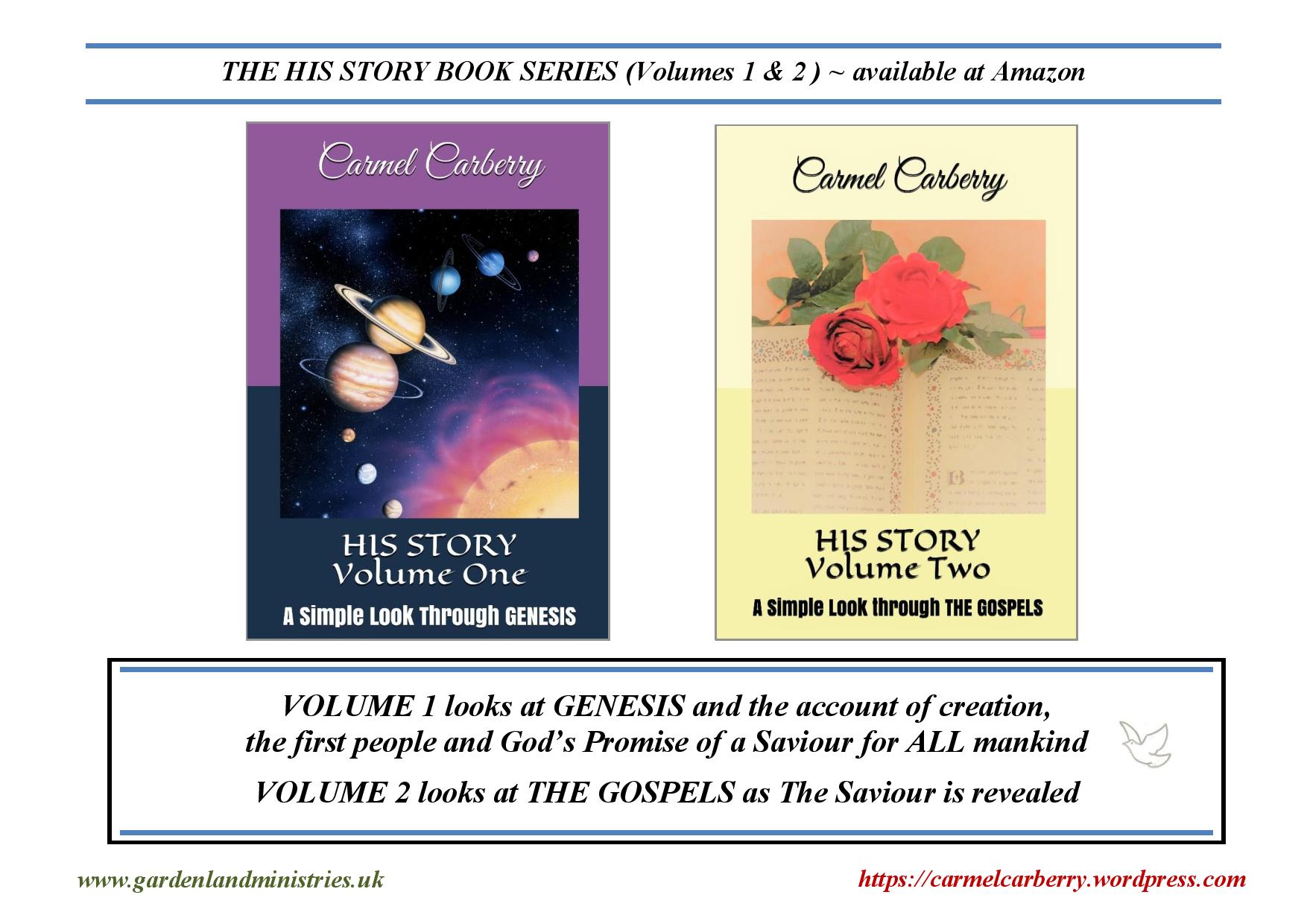
Some extracts to enjoy from the first two books in the HIS STORY series ~ Volume One offers a simple look at GENESIS and Volume Two offers a simple look through THE GOSPELS
Creation
There is much debate about the subject of Creation. It’s worth remembering that The Bible tells us ‘nothing is impossible for God’ (Matt 19:26 / Luke 1:37). Bearing this in mind, it could be possible for Him to create the earth in six days ~ even if this seem implausible to our own natural minds (Prov 3:5).
In the New Testament, Jesus frequently spoke to His listeners with the same notion that this is how God created the world. The Bible tells us that death and decay was not a feature of the original earth but became part of our existence as a result of the fall of mankind (Gen 3). The Apostle Paul in the New Testament also taught that creation was a supernatural event, which was then affected by suffering after the fall.
But God sent His Son Jesus to bring a solution to the need of mankind, which is the main principle that The Bible is trying to teach us. Man needed a Saviour and God sent His Son to redeem that which was lost and provide for a new heaven and earth yet to come, where death and decay will no longer have any place. As we set our hearts and minds and Him, Christ will lead us into victory in life today, in this world, as well as the everlasting to come.
The Word becomes a human being
Before all time, Jesus existed. God ‘spoke’ all creation into being through His ‘Eternal Word’ (Jesus, His Son). Jesus is God’s ‘Everlasting Light’ who shines for all mankind. His Light came into the world in the form of a human being: God Himself visited mankind upon the earth in the Person of His Son. God’s Light appeared to a nation who had a history of men and women that had put their trust in God, even though they had not seen Him; they heard about Him and believed.
The Light was born as a human being (into a human family) from the historical line of a man named Abraham. The descendants of Abraham had grown into a small but resilient nation, whom God had spoken to across the ages. God wanted to speak through this nation (called ‘Israel’) to speak to all nations; therefore He sent His Son into this genetic line to make Himself known to all people.
The Birth of John The Baptist
A man named Zacharias (who was one of the nation’s priests) and his wife Elizabeth, had long wanted to have a child but Elizabeth was not able to have children. In their old age, an angel appeared to Zacharias with a message from God, promising that his wife would have a child despite the odds against them Initially the priest was filled with unbelief and could not speak. Elizabeth became pregnant, and when the child was born, Zacharias’ speech returned, and he named the child ‘John’ (which means ‘God is gracious’) ~ the child John later became known as ‘John The Baptist.
Mary and Joseph
During the time Elizabeth was pregnant with her child John, an angel also appeared to her cousin Mary, to tell her that God’s Spirit would bring about the supernatural conception of a child in her womb and that she was to name Him ‘Jesus’ (which means ‘Saviour’). Mary believed God’s Word, then went to visit her cousin with the good news. The moment Elisabeth and Mary met, ‘John’ (while still in his mother’s womb) jumped for joy, and the two women rejoiced together and praised God.
An angel also spoke to the man that Mary was engaged to marry, Joseph, to reassure him to take Mary as his wife and to bring up the child she carried, and be a family. Joseph was a man of honour and integrity, so he obeyed God and took care of Mary and her child. The Roman Emperor of the time ordered that a census be taken in Israel, which required all citizens to return to their home town to register. Therefore, while Mary was still pregnant, Mary and Joseph travelled to Bethlehem to register for this census. After several days of travel, Mary and Joseph arrived in Bethlehem, searching for a place to stay.
The Birth of Jesus
At Bethlehem, all the Inns were full, but one Innkeeper (on seeing that Mary was due to give birth soon) told Joseph that they could stay in his stable instead. So, they settled down for the night alongside the animals. Mary went into labour and gave birth to Jesus in the stable. They made a bed for him in an animal’s feeding trough (known as a manger). About this time, an angel appeared to some shepherds who were keeping watch over some sheep in the fields near Bethlehem.
The angel told the shepherds that the Saviour had been born and told them where to find Him, to go and honour Him. Then a chorus of angels appeared and sang praises to God. So, the shepherds went to find the baby laying in the manger (just as the angel had said) and worshipped Him. After some time, some wise men (also known as ‘The Magi’) saw a magnificent star that had rested over the place where Jesus lay. These ‘wise men’ (also known as ‘Stargazers’ or ‘Astronomers’) travelled from a far eastern country to find the new born king.
On their way, the wise men met with Herod (the King of Judah at that time). Herod told the men to come back and tell him where the baby was. But Herod’s intention was not as he said (to ‘worship the child’) but to kill the child. The Wise Men followed the Great Star and found the child. They worshipped Him and gave gifts of gold, frankincense and myrrh. But they travelled back to their home country by a different route to avoid Herod, recognizing his real intentions.
Dedication at the Temple
The religious practice of the land was to take the first boy child of a family to The Temple at Jerusalem, where the parents would make an offering of thanks to God. So, when Jesus was 40 days old, Mary and Joseph took Him to The Temple and brought a pair of young pigeons to be their offering. There was a man in Jerusalem named Simeon (a man who had dedicated his life to God). He was now very old but was resting on the promise that God gave him from years before that he would not die before seeing The Saviour.
One day, Simeon felt The Holy Spirit’s prompting to go to The Temple. So, he went and was there when Joseph and Mary came in with Jesus to present their offering. When Simeon saw the child, God spoke to him to tell him that this was (is) the promised Saviour. With great rejoicing, Simeon took Jesus in his arms and blessed Him, gave thanks for Him, and thanked God for letting Simeon see ‘The Christ’ as He had promised. Simeon also blessed Mary and Joseph, and prophesied of things to come.
Simeon told Mary of great things that her child would do but also warned her that ‘sorrow would pierce her heart like a sword’ (this was a reference to The Cross). At the same time, a woman named Anna was also in The Temple (she too had dedicated her life to God, and spent much of her time praying). The Holy Spirit revealed to her too that the child was The Saviour, so she gave thanks to God and she told others in The Temple that The Redeemer had come.
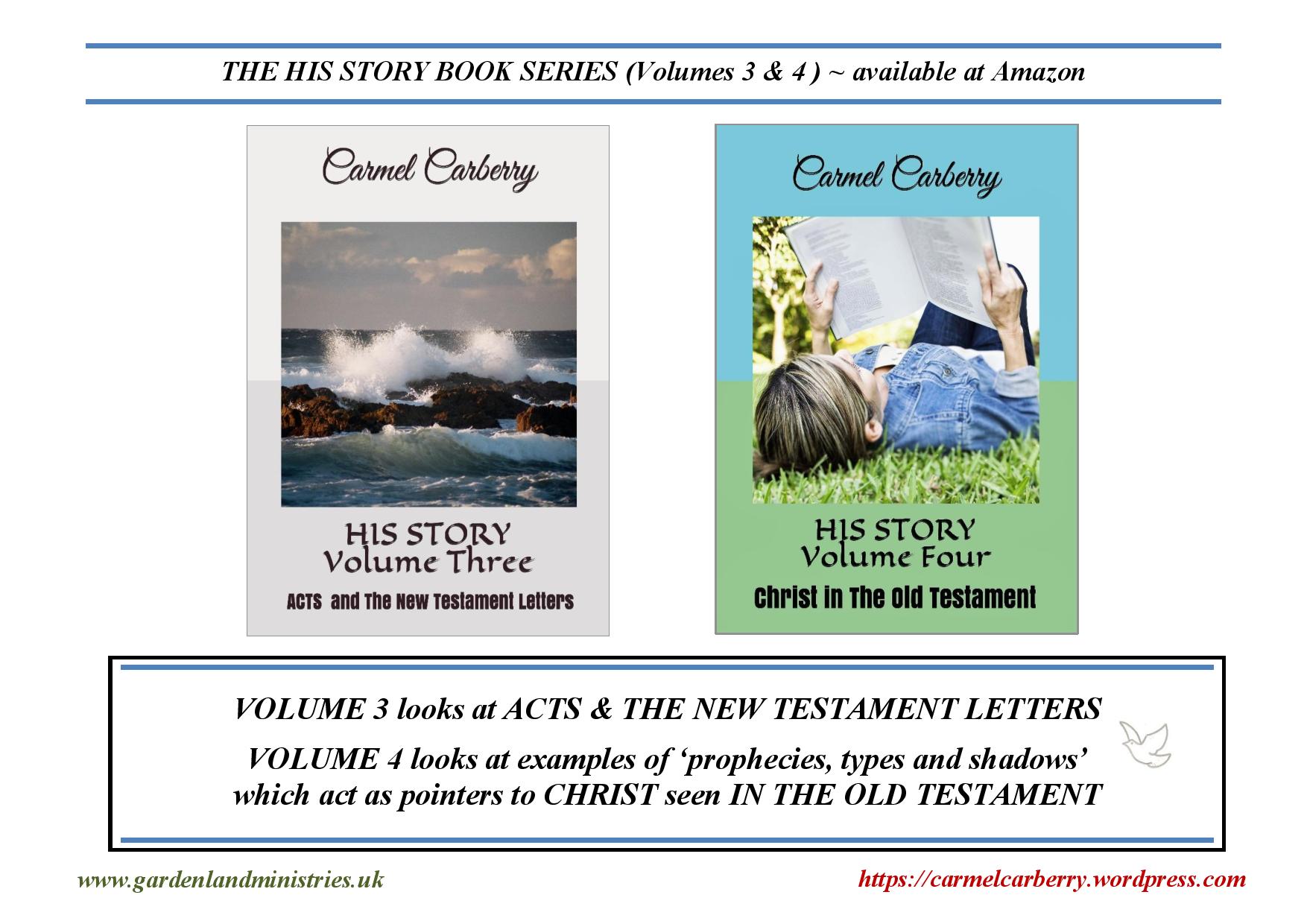
Further extracts to enjoy from Volume Three of the HIS STORY series looking at ACTS and THE NEW TESTAMENT LETTERS; and Volume Four looking at CHRIST IN THE OLD TESTAMENT
‘ACTS’ is considered to have been written around 67 AD. It is the second letter written by Luke to a man named ‘Theophilus’ (believed to have been a Roman Government Officer). Luke’s first letter is the book we know today as ‘The Gospel of Luke’.
Luke 1:1-4 / Acts 1:1-2
Many people have set out to write accounts about the events that have been fulfilled among us. They used the eyewitness reports circulating among us from the early disciples. Having carefully investigated everything from the beginning, I also have decided to write an accurate account for you, most honorable Theophilus, so you can be certain of the truth of everything you were taught…In my first book I told you, Theophilus, about everything Jesus began to do and teach until the day He was taken up to heaven after giving His chosen apostles further instructions through the Holy Spirit.
Acts tells us about the outpouring of God’s Spirit on the followers of Jesus after His ascension to Heaven (Acts 1-2), and how His Spirit empowered the believers to spread God’s Message about Christ. In Acts chapters 1-7 we see the Apostle Peter and his fellow believers begin to preach to Jewish people in and around Jerusalem. In chapters 8-12 we see the Apostle Philip and his fellow believers take the Good News of Jesus to Judea and Samaria. In chapters 13-28 we see The Apostle Paul take the Gospel to the Gentiles as he takes ‘Missionary Trips’ to other nations, which ultimately is still spreading the message to the world today.
The final chapter of Acts records an account of Paul being under arrest in Rome and awaiting trial (Acts 28:17-31). With this in mind, there is a compelling belief that Luke’s writing was to provide a background history to Theophilus, the Governmental Official who represented Paul at his trial. The aim of Luke’s letters appear to be to inform Theophilus of events prior to Paul’s arrest, to help give evidence in support of Paul’s innocence under Roman law. Today, the Book of Acts offers the reader a special insight into how The Church began.
A group of frightened believers (who were in prayer but hiding from the authorities) became bold witnesses for Jesus, when the promised Holy Spirit (Joel 2:28 / Acts 1:8) came upon them at Pentecost (Acts 2). Empowered by God’s Spirit, these people (often weak and uneducated) went on to preach with miraculous signs and wonders following them. Despite desperate trials and persecution, the believers grew in great numbers. And they continued to speak His ‘Message of Reconciliation’ to all who would listen (2 Cor 5:17-21). This message continues to go out today to ALL people, in ALL nations, ‘to the ends of the earth’ (Acts 1:8)
So many people are looking for God, all over the world, in many different ways. ‘Acts’ tells us that Jesus came for everyone, both Jew and Gentile (non-Jew) everywhere, across all time. And God’s Holy Spirit has been given to help, guide and teach us. All of this is by God’s Grace and Mercy, given freely, as we look to His Son.
Word of encouragement from The Father’s Heart
I promised from ancient times to pour out My Spirit on all mankind, and to give My blessing to every man, woman, and child in all nations across the earth. My Promise is being fulfilled ~ My Spirit descended on The Day of Pentecost and He is present today. He lives within the hearts of all who trust in Jesus. I sent forth My Spirit to comfort and guide people into all truth. Therefore, take heart all you who hope in God. I have not forgotten you. I have fulfilled My Promise, and through My Spirit I will work all things together for good, as you pray and seek Me first in your life. I AM with you, always. I dwell in your heart by the power of My Spirit, and in the Love of My Son. I will never leave you.
For Bible Study (if desired) ~ Ps 27:14 / Is 44:3 / Joel 2:28-29 / Matt 28:19-20 / John 3:16-17 / John 14:16 / John 16:13-14 / Acts 2:1-4 / Acts 2:17+39 / Acts 10:45 / Rom 8:28 / 2 Cor 1:20-22 / Gal 4:6 / Heb 6:10 / Heb 10:10 / Heb 13:5 / Eph 1:13-14 / / Eph 2:18-22 / 1 John 2:2
The Meaning of ‘Types and Shadows’
The Bible is an incredible collection of books which show how God has progressively been revealing Himself to mankind. He has been working throughout history to bring eternal salvation for all people, for all time, in the Person and work of His Son (John 3:16-17 / Heb 10:1-25). In the Old Testament, God frequently gives promises that a Saviour would come to break the curse of sin (referring to the ‘fall of man’ recorded in Genesis 3). He promised that The Saviour would redeem all mankind ~ in The New Testament we see these promises fulfilled in Jesus.
Christ is seen through multiple prophesies about Him, and through many ‘types’ and ‘shadows’ ~ which are pictures and pointers ~ from the lives of various people in the Old Testament. There are also places, rituals and ceremonial laws that point to Him. These pointers, when looked at together, serve to build up a wider picture of the kind of Person the Saviour (also called ‘Messiah’) would be. They also confirm the life and events that He would fulfil.
The Gospel writer Matthew (in the New Testament) often speaks of Old Testament prophecies having been fulfilled in Jesus’s life. Matthew uses statements such as “this took place to fulfil what the Lord had spoken by the prophet…” (for example: Matt 1:22-23 / Matt 2:5+7 / Matt 3:2-3). The key point spoken of throughout the Bible is the need to restore the relationship between God and man.
When God created the world (Gen 1-2), the first people walked with God in perfect fellowship. Then, from Genesis chapter 3 onwards, we read the account of the ‘fall of man’ and the negative effects that resulted thereafter. God still communicated with people; but sin, fear and shame had entered the once perfect world. The creative order began to enter into a chaotic pattern which produced terrible consequences over the passage of time.
As The Bible speaks its message, it tell stories of God working in the lives of various people to bring about His unfolding plan of redemption. It tells the story of the development of the nation Israel and its many ups and down over the ages. This nation, and the individuals relating to it, are focused upon because The Redeemer (Saviour / Messiah) was promised to be born out of this nation when God spoke to Israel’s Ancestors and Patriarchs (the fathers of the nation: Abraham, Isaac, and Jacob).
Jesus (The Saviour) was (is) fully divine, and also fully human. He was Jewish and lived under The Old Covenant Law of Israel, which He obeyed and fulfilled perfectly. Jesus said that ‘all the prophets’ and ‘all the Scriptures’ spoke of Him (Luke 24:27). We can now look back and see that The Old Testament pointed to Jesus all along. ‘The New’ sheds light upon ‘The Old’.
Luke 24:27 from The Amplified Bible says… beginning with Moses and [throughout] all the [writings of the] prophets, He (Jesus) explained and interpreted for them the things referring to Himself [found] in all the Scriptures.


You must be logged in to post a comment.